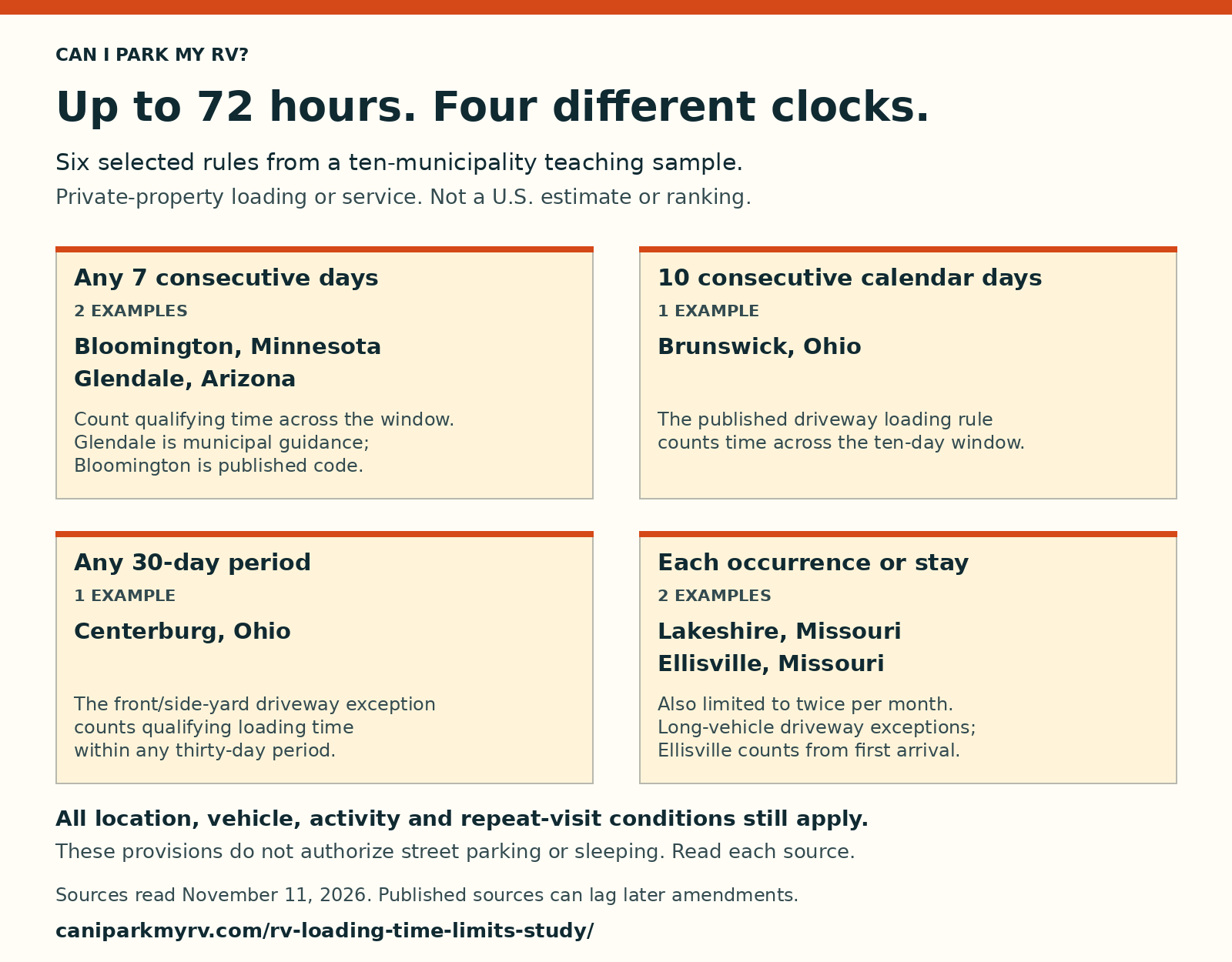
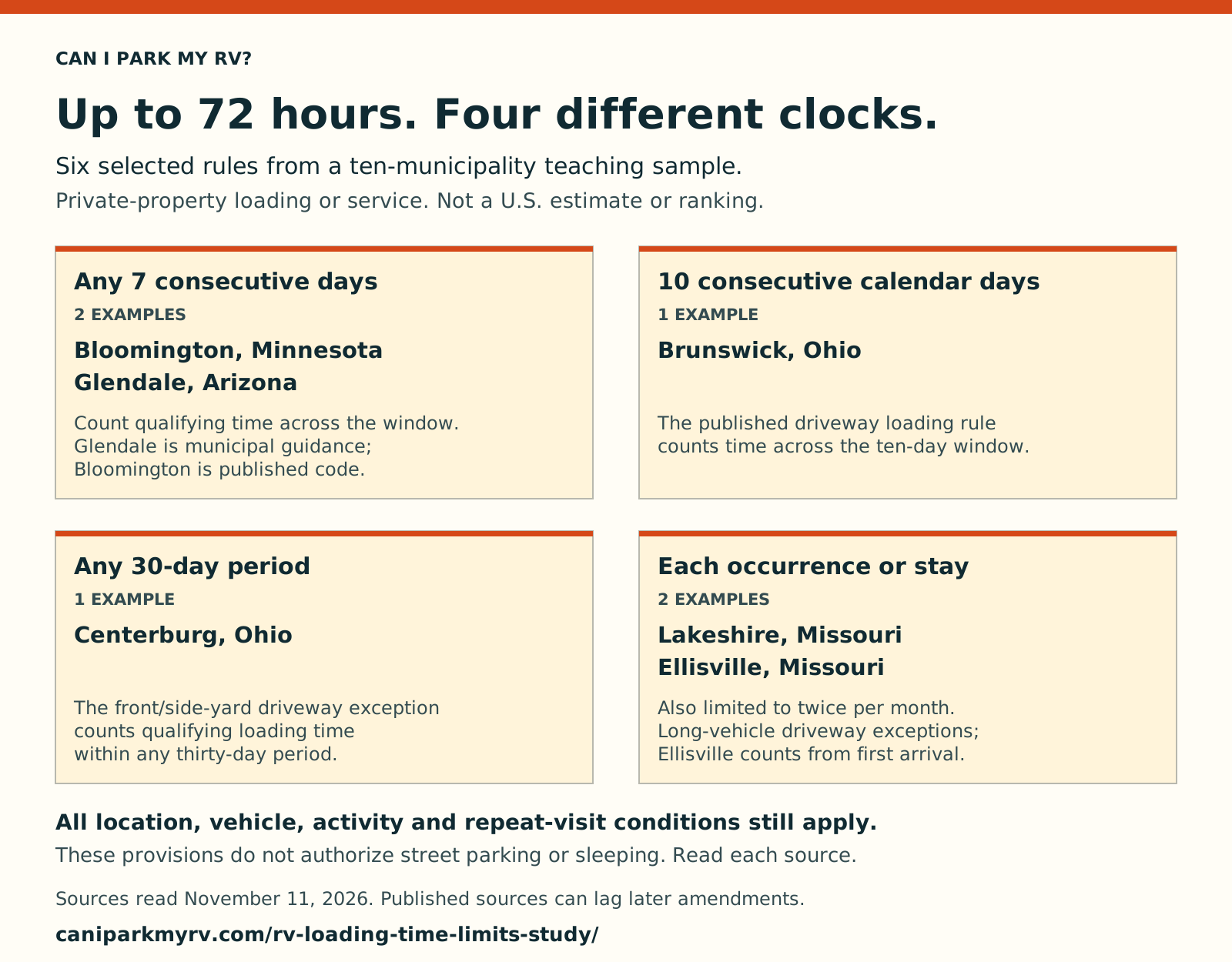
72 hours in 7 days
2 examples: Bloomington, Minnesota, and Glendale, Arizona. Count qualifying time within seven consecutive days.
Municipal rule comparison ·
Six provisions in this ten-municipality sample use a 72-hour limit. They use four different time-accounting models. A number without its location, activity and repeat-visit rules can give the wrong answer.
These are selected examples, not a national estimate. Each concerns a private-property loading or service provision, not ordinary street parking. All other local conditions still apply.
2 examples: Bloomington, Minnesota, and Glendale, Arizona. Count qualifying time within seven consecutive days.
1 example: Brunswick, Ohio. The published driveway rule uses ten consecutive calendar days.
1 example: Centerburg, Ohio. The front/side-yard driveway exception uses any thirty-day period.
2 examples: Lakeshire and Ellisville, Missouri. Their long-vehicle driveway exceptions also cap use at twice per month.
Download the four-clocks graphic (PNG)Download the linked vector graphic (SVG)Caption and source links
The graphic preserves the inclusive limit, twice-monthly cap, source-type distinction and sample limits. Its SVG links each municipality to the corresponding evidence row. Use it with the full table and source-linked caption; do not crop away the scope or source-date notes.
Returning home does not automatically create a fresh allowance. In a rolling-total rule, earlier qualifying time still counts while it remains inside the stated window. An occurrence limit adds a different constraint: a third short stay can fail even if each stay is well below 72 hours.
Read across the row, not just the hours. “Up to” includes the stated boundary; “less than” does not. This table summarizes selected provisions rather than every rule applying to a parcel. Use “Link to this rule” to cite an individual example. Publication labels identify the recorded edition or document; they are not effective dates or a guarantee that a source includes later amendments.
| Municipality | Time accounting | Where and for what | Conditions and source |
|---|---|---|---|
| Bloomington, MN Link to this rule | Up to 72 hours Any 7 consecutive days | Driveway in R-1A, R-1 or RS-1 single-family zoning; RV no longer than 40 feet. Activity: Loading, unloading or routine maintenance. | Other location, ownership and vehicle conditions remain; major mechanical work requires a completely enclosed building. No sleeping permission. 21.301.13(c)(2)(F) · Published municipal code Publication label: 2026 S-16. Read November 11, 2026. |
| Glendale, AZ Link to this rule | Up to 72 hours Any 7 consecutive days | Temporary front/side-yard, driveway or maneuvering-area placement. Activity: Loading, unloading or repairs. | City guidance; separate repair and site requirements apply. This is not an RV street-parking or sleeping allowance. Residential Parking Codes, page 1 · Official municipal guidance Publication label: City parking brochure, 2025 file. Read November 11, 2026. |
| Brunswick, OH Link to this rule | Up to 72 hours Every 10 consecutive calendar days | Driveway on improved residential property. Activity: Loading or unloading. | City registration, resident ownership, operability and other vehicle requirements remain. No living or housekeeping use. 1480.07, added 302.9(b) · Published municipal code Publication label: 2026-02. Read November 11, 2026. |
| Centerburg, OH Link to this rule | Up to 72 hours Any 30-day period | Temporary driveway placement otherwise restricted in front/side yards in residential zoning. Activity: Loading or unloading. | The separate rear-yard restriction for units 32 feet or longer needs local review; this summary does not resolve that overlap. No living quarters or business use. 1115.05(c)(1)(E) · Published municipal code Publication label: 2026-01. Read November 11, 2026. |
| Lakeshire, MO Link to this rule | Up to 72 hours Each occurrence At most 2 per month | Driveway exception for boats, trailers, campers or RVs 30 feet or longer. Activity: Loading or unloading. | No right-of-way encroachment. The section has a 2-acre-property exception and other special routes. The conditional street route has a separate 24-hour limit. 500.040, amended 302.8.4(a)(i) · Published municipal code Publication label: Posted code with 2025-04-14 date. Read November 11, 2026. |
| Ellisville, MO Link to this rule | Up to 72 hours Each stay, from first driveway arrival At most 2 per month | Driveway exception for boats, trailers, campers or RVs 30 feet or longer. Activity: Loading or unloading. | No right-of-way encroachment. The section has a 2-acre-property exception and other special routes. The conditional street route has a separate 48-hour limit. 500.040, amended 302.8.4(a)(i) · Published municipal code Publication label: Posted Chapter 500. Read November 11, 2026. |
| Cleveland, OH Link to this rule | Up to 48 hours Any 21 consecutive days | Parking or driveway area on the premises in a residential district. Activity: Loading or unloading. | The exception is private-property placement, not a public-road allowance. Other applicable conditions must still be checked. 337.19(b)(3) · Published municipal code Publication label: 2026 S-28. Read November 11, 2026. |
| Lisle, IL Link to this rule | Up to 96 hours Each driveway stay At most 2 per month | Driveway on a residential lot. Activity: Loading, unloading, maintenance or repairs. | Major repairs must be inside an enclosed garage. The longer service allowance does not permit living or business use. 5-13-10(C)(5) · Published municipal code Publication label: 2026 S-19. Read November 11, 2026. |
| Toledo, OH Link to this rule | Up to 24 hours Any calendar week | Temporary driveway placement under residential-district rules, notwithstanding the section's setbacks. Activity: Loading or unloading. | Other requirements, including no living/housekeeping or fixed utility connections, remain. The public-street clock is separate. 1107.1802(G) · Published municipal code Publication label: 2026 S-105. Read November 11, 2026. |
| Tontitown, AR Link to this rule | Less than 8 hours A loading/unloading period Not specified in cited clause | Residential-lot placement between the residence/structure and street. Activity: Loading or unloading. | Exactly 8 hours is outside this wording. Resident ownership/use, registration and no living/sleeping/housekeeping apply. Section applicability to established sites needs confirmation. 153.210(A)(7)(b) · Published municipal code Publication label: 2026 S-67. Read November 11, 2026. |
Do not reset a rolling clock at every arrival. In Brunswick, two 36-hour loading periods inside the same ten-consecutive-calendar-day window use 72 hours. Another hour inside that window exceeds the cited time limit, even after leaving between visits.
Do not substitute trip count for total time. In Lisle, three 12-hour service visits in a month exceed the two-times-per-month condition despite totaling only 36 hours. Conversely, two visits do not excuse a stay exceeding 96 hours.
Do not round a strict boundary into permission. Tontitown’s selected loading clause is less than eight hours. Exactly eight hours does not fit that wording; the site and section-applicability questions still need confirmation.
These examples illustrate the cited time arithmetic only. They do not determine that a vehicle, activity or property qualifies.
Bloomington names routine maintenance alongside loading and unloading; Lisle also names repairs but keeps major repairs inside an enclosed garage. Glendale’s official brochure names repairs, with separate repair restrictions elsewhere in the same publication. The other seven selected clauses name loading and unloading, without adding a general maintenance allowance.
That difference matters before using a weekend repair project as “trip preparation.” A separate local provision may answer the repair question. Silence in the particular loading clause is not proof that repairs are prohibited everywhere.
Likewise, a longer driveway clock is not a longer street allowance. Lakeshire and Ellisville illustrate the distinction: their conditional long-vehicle street routes use different, shorter periods. Do not carry a private-property number onto the curb or use it as permission to sleep.
Annual totals, permit renewals, calendar-day counting and vehicle counts add different constraints. These four selected provisions form a separate supplement to the ten-row comparison above. Neither group is a representative survey, and the original six-of-ten finding does not describe this supplement.
| Municipality | Time and repeat limits | Scope and activity | Conditions and source |
|---|---|---|---|
| Ridgeland, MS Link to this example | At most 5 consecutive days At most 30 days per calendar year Partial-day counting is not specified in the selected clause; retain days rather than converting to hours. | Front- or side-yard driveway; RVs, transient/travel trailers, motorhomes and similar equipment. Activity: Loading, unloading, cleaning or minor repairs. | Other driveway/site rules remain. Special-circumstances permits require City approval; the screened side/rear storage route is separate. No sleeping permission established. 37.02(A)(2)(d), PDF page 55 · Published municipal code Publication label: Amendments incorporated May 7, 2026. Read November 11, 2026. |
| Prospect, KY Link to this example | At most 72 hours with an issued City permit At most 3 resident permits per calendar year; no renewal within 1 week after initial issuance unless the City determines the specified emergency. Renewal restriction runs from initial permit issuance, not departure. | Resident's own listed vehicle on the dwelling driveway, not grass; residential-area provision. Activity: Loading, unloading, cleaning, repairing or servicing. | Display the permit prominently. The nonresident-guest paragraph is separate. No sleeping or utility permission inferred. Published code reports ordinances only through December 16, 2024. 72.13(B)-(C), read with (A); guest route in (D) is separate · Published municipal code Publication label: 2025 S-14; ordinances through December 16, 2024. Read November 11, 2026. |
| Dardenne Prairie, MO Link to this example | At most 2 consecutive calendar days Thereafter, at least 2 consecutive calendar days with no recreational vehicle, recreational equipment, pickup camper or trailer parked on the same residential lot. Any part of a day parked counts as the entire calendar day; not a 48-hour stopwatch. | Residential lot, except the separate R-1A route; recreational vehicles, equipment, pickup campers and trailers. Activity: Loading and unloading. Unit count: Not encoded for the selected loading route; the separate R-1A route has its own one-RV limit. | General paving and vehicle-classification requirements remain. The street-loading rule is separate. No sleeping or utility permission established. 350.340(B)(4)(c) and (c)(1); R-1A exception in (b) · Published municipal code Publication label: Posted code includes legislation through June 3, 2026. Read November 11, 2026. |
| Winfield, IL Link to this example | At most 7 consecutive days At most 14 calendar days during any month Keep the consecutive-day and calendar-month limits together; the selected clause does not specify partial-day rounding. | Existing driveway on a residential lot; RV, boat and trailer, or recreational/utility trailer. Activity: Unloading, loading, maintenance or repairs. Unit count: At most 1 listed unit owned by a permanent occupant of the dwelling. | Inoperable vehicles require a secured enclosed structure. Guest parking and ordinary storage are separate routes. No sleeping or utility approval inferred. 10-9-4(H)(8)(c)(2); inoperable-vehicle condition in (4) · Published municipal code Publication label: 2026 S-17. Read November 11, 2026. |
Dardenne Prairie’s selected outdoor lot-loading provision combines a two-calendar-day ceiling, whole-day counting for any part of a day, and then two consecutive calendar days clear of the listed equipment on the same lot. The fictional schedule below shows how those conditions interact. It is not another observation in either study dataset.
Assumptions: A qualifying loading visit starts Monday at 11:30 p.m. and ends Tuesday at 12:30 a.m., in a week without a clock change. The lot is outside the separate R-1A route, and earlier parking history does not prevent this visit. No recreational vehicle, recreational equipment, pickup camper or trailer remains on or returns to the lot after departure through Thursday.
Arrive at 11:30 p.m.
Thirty minutes touches this calendar day.
Leave at 12:30 a.m.
This is a parked day, not a clear day.
No listed equipment on the lot for the entire calendar day.
Keep the entire calendar day clear, through the start of Friday.
The illustrated absence condition is met. This is not a parking approval.
Count the lot’s history, not just one vehicle’s absence. The condition covers all four listed equipment classes on the same lot. A replacement RV or trailer is not a fresh clock. Keep the R-1A exception, vehicle classification, paving, enclosed-storage route and other requirements separate; the timeline establishes no permission for street parking or sleeping.
Source: Dardenne Prairie §350.340(B)(4)(c) and (c)(1), read November 11, 2026, with (A), (B)(1), (B)(4)(b) and (C) for scope. The publisher’s code index reports legislation through June 3, 2026. Later enactments have not been fully reconciled here. This is an illustration of the published text, not a City determination for a property.
Method and limits: These four additions were selected from existing guides for distinct private-property loading or service conditions and reread in published municipal code. The downloads preserve native units as text, including what the selected clause does not specify. They do not recode days into hours or claim that all later ordinances have been reconciled. The source-read dates shown do not advance the linked guides’ full review dates.
To cite an additional example, use its row link and municipal source, retaining the time and repeat limits, counting rule, scope, activity and conditions. The original ten-row hours comparison remains available separately.
Question: What information gets lost when an RV loading rule is reduced to a number of hours?
Sample: Ten municipal examples in six states, chosen from existing Can I Park My RV? guides for explicit numerical private-property loading provisions and readable municipal sources. This is a purposive teaching sample, not a random survey, a list of the largest cities or an estimate for all U.S. jurisdictions. Source availability and the existing guide inventory affect which examples appear.
Evidence: Nine rows use published municipal-code text; Glendale uses official municipal guidance and is labeled accordingly. The linked provisions were read on November 11, 2026. Published codes can lag adopted amendments. This comparison did not independently clear every later ordinance, map, special approval or parcel-specific condition, and it does not advance the broader legal-review dates on the linked guides.
Coding: One row represents one selected private-property loading provision. The downloadable data separates the boundary operator, hours, accounting period, occurrence cap, place/vehicle scope, activity, conditions, source type, edition and read date. A period without an explicit recurrence rule is recorded as unspecified, not unlimited. The strict eight-hour boundary is kept distinct from an inclusive maximum.
Exclusions: Public-street permits, abandoned-vehicle or towing thresholds, general storage limits and guest-occupancy windows are not pooled into these figures. We report no average “allowed parking time” because the conditions are not interchangeable. Six of ten using 72 hours describes only this selected sample.
Lincoln, Nebraska illustrates the distinction. Section 10.32.070 restricts its listed vehicles and combinations over 21 feet long or 7 feet wide beside R-1–R-8 property. For a defined cabin trailer or self-propelled mobile home, its exception allows only the time necessary for expeditious loading, unloading, delivery or collection of goods, wares, merchandise or materials, with a four-hour maximum. The separately named truck, semitrailer, trailer and truck-tractor use a two-hour maximum for that activity. The section separately exempts semitrailers, trailers, trucks and truck-tractors being used in construction, repair, service or moving operations; this is not a general RV-maintenance exception.
A different provision, §10.32.190, prohibits parking or standing longer than 24 hours on one side of a street within a block. The 24-hour ceiling does not extend either loading exception or establish a reset procedure. The figures must not be added, averaged or reduced to one “allowed RV parking time.” Confirm the full vehicle/towing configuration, activity, adjoining zoning, measurements, location, shorter controls and exceptions; overlapping classes or tow combinations do not automatically receive four hours.
This is an example of why the datasets have a defined scope, not another observation in either the ten-row comparison or four-row supplement. It adds no national finding or general parking permission. The selected street clauses were reviewed November 11, 2026; a complete later-ordinance cutoff remains unconfirmed. Read Lincoln’s complete street conditions and source limits.
Link to this scope example · Download the example with sources
Cedar Park, Texas shows why the numbers elsewhere in a parking article cannot fill a missing loading-duration field. Its public-roadway and right-of-way rules contain three different conditions. The loading exception below concerns a platted subdivision zoned or used for a permitted residential use. Defined RVs and trailers are separate covered classes, so the section’s size thresholds do not exempt small RVs:
The citywide 10 p.m.–6 a.m. restriction for RVs and trailers in §17.04.010 separately lists emergency repair/service or an issued permit as exceptions; loading alone is not listed. Street habitation is prohibited, and signs, clearance and other restrictions still apply. Read Cedar Park’s street rules and source limits.
For data reuse: Record the loading endpoint as “immediately on completion,” keeping the permit periods and fee separate. An activity limit without a stated number of hours is not unlimited permission. This public-street example is outside both the ten-row comparison and four-row supplement; it changes neither dataset nor the six-of-ten finding.
Source basis: published Article 17.04 and Appendix A §10.100, read November 11, 2026. The code index records legislation through June 25, 2026. The targeted source review does not certify that every later enactment is included or advance the local guide’s full review date.
The four additional examples have separate downloads and retain native calendar-day and permit units; they are not pooled into the original ten-row finding.
The CSV and JSON contain the same ten records. Each has a stable row_id and a row_url pointing to its table row above. The dictionary explains every field, empty values, source labels and the grouping behind the main finding.
One row, one selected provision. Fields summarize the cited provision; they are not verbatim quotations or a complete parcel-eligibility check. The CSV has a header and ten records; the JSON keeps the same records in its rows array, alongside study limits. Only hours is numeric in JSON; the other row fields are text. Match records by row_id, not their position.
Reproduce the six-row finding: select hours = 72 and operator = at most. Group rolling-total rows by period. Combine rows with clock_type = per occurrence with monthly cap and occurrences = At most 2 per month into one model, while retaining their different period wording. This gives counts of 2, 1, 1 and 2: Bloomington and Glendale use seven consecutive days; Brunswick uses ten; Centerburg uses thirty; Lakeshire and Ellisville use each occurrence or stay with a twice-monthly cap. Ellisville also specifies first driveway arrival. That produces the four groups shown above. Do not turn them into a national percentage, an average allowed stay or a ranking of permissiveness.
Suggested attribution: Can I Park My RV? (November 11, 2026), “RV Loading Time Limits: 10 Local Rules Compared.” For an individual example, link to its table row and the municipal source. Retain the city and state, duration and boundary, accounting period, occurrence cap, scope, activity and material conditions. Include the source section, publication label and read date. Check the linked source before relying on a rule for a current decision; this comparison is not a substitute for it.
When describing the finding: “Among ten selected municipal examples, six use a 72-hour private-property loading or service limit, but those six use four different accounting models. The comparison is not a representative survey of U.S. parking rules.”
See our research method and editorial policy. For an actual trip, start with your jurisdiction guide and confirm the address, vehicle, activity and recent parking history.